After the first few days of black lives matter protests, I began to explore the Jewish relationship to blackness. I came to realize that the plight of African Americans remains my responsibility as long as blackness stays rooted in Jewish identity and tradition. If that sounds extreme, then I urge you to keep reading this brief exposition of the topic.

black tzipporah.jpg

In Torah this week, we have an example of “blackness” as inferiority. Miriam and Aaron spoke against Moses because of the Cushite woman he had married: “He married a Cushite woman!” Numbers 12:2. You may recall that Tzipporah, Moses’ wife, was a Midianite. The Cushites were North Africans with dark skin. In the context of these murmurings, Miriam and Aaron were likely insulting Tzipporah by calling her black. God immediately punished Miriam with a skin disease, affirming Miriam’s offense.

Later texts denigrate the descendants of Noah’s son Ham as dark skinned. After Noah’s sea voyage, he planted a vineyard, made wine, and got clothes-shedding drunk. Ham called attention to Noah’s inebriation while his brothers cloaked and guided their father home. In rabbinic literature, Ham’s descendants were thought to bear the mark of Ham’s shame through their blackness.

Throughout Hebrew literature of the rabbinic period, the image of black or dark became associated with malevolence and danger. An example is found in Genesis Rabbah, a midrashic text from the period of 300 – 500 C.E., which addressed the story of Abraham and Sarah travelling to Egypt after first experiencing famine in Canaan. “We passed through Aram-Naharaim and Aram-Nahor, and we did not find a woman as beautiful as you [Sarah]. Now . .  . we are entering a place of the ugly and the black [i.e., Egypt]” [Gen. 12:13] (Gen. Rabbah loc. cit.).

In part due to our own Jewish scriptures, the concept of “blackness” as inferior suffused theories of race. What we understand as racist, finds a foothold in Jewish texts, where dark skin, as a physiological sign, represented inferiority. The subservience of the black race became a foundational story of Western Civilization. Later, proponents of Black African slavery could look to Jewish writings for a reasoned justification of slavery. For example, some Christian religious leaders speaking as apologists for slavery used the story of Ham to justify servitude.

The irony of these Jewish views of blackness is how Jews were thought to be dark skinned, both literally and figuratively, by oppressive Christian leaders from the Middle Ages until the 20th Century. As Jews immigrated to the United States to escape poverty and oppression in Europe, they remained excluded and derided similar to black Americans. Only in recent decades did Jews become “white” Americans, in wealth and status. The occasional act of anti-semitic violence reminds us of the fear of being “black.”

Reverend Anthony A. Johnson, writing for the Jerusalem Post on June 2, 2020, explained: “My black is beautiful. And your black is beautiful. Stop trying to pass as white (to those who are white passing) and let yourself experience the “inconvenience” of being people of color (which is what you are) even if you’re a fair-skinned Ashkenazi Jew.” 

To address Jewish American responsibility for the imperiled status of African Americans, we must do more than empathize. We must see ourselves as black. We undergo this very exercise every Passover when we are told to see ourselves as if we too were freed from slavery. We must again identify as and with the oppressed, the victim, and the enslaved to help our country heal and achieve justice for all. We must uproot injustice and restore the dignity of every living being created in God’s image.

Rabbi Evan J. Krame

I am distressed about the two tragedies of this year, the Covid-19 pandemic and violence against African Americans. My response is to become a crusader, but that response is quite different in each case.

Covid-19 is public enemy number one and I have become the mask police. Like Batman, I’m engaging with some Jokers and Riddlers.

I entered a restaurant to pick up food.  A young couple stood giggling inside the doorway. Their masks were pushed aside. Noticing me on the other side of the door, they waved me in! I refused to step inside. I asked them to leave because they didn’t wear their masks properly.

In the supermarket, a man brushed past me sipping a cup of coffee. His mask was dangling below his chin. I asked him to put on his mask. The man responded, “how am I supposed to drink my coffee?” I said, you aren’t supposed to be walking around with coffee!

These mask infractions are reminders that this pandemic will continue as long as people are self-centered and self-important. Only when we care as much for others as we do for our own safety will the pandemic abate.

My response to mask offenders is crude and brash. I have wondered, am I as willing to be as outspoken regarding violence agains African Americans?

I am deeply troubled to see other people so wronged. Racism infects our society and defiles our nation. And I must acknowledge that I remain privileged by virtue of my skin color.

This week in Minneapolis, a white policeman killed a black man. George Floyd was suspected of passing a counterfeit twenty-dollar bill. Officer Derek Chauvin used his knee to keep Floyd in a neck hold . . .  until Floyd died. Cities have exploded in protest.

In February, two armed white men chased a young black man jogging near Brunswick, Georgia. Ahmaud Arbery was suspect only because he was black. His murderers, Gregory and Travis McMichael, grabbed their shotguns and killed Arbery in cold blood.

Confronting mask offenders is easy. Standing against racial injustice in America is a lot harder.  My mismatched faces-to-mask encounters are quaint. The protests responding to the murders of Arbery and Floyd are deadly serious.

Fear, prejudice and violence will only end when individuals take on the responsibility of change. Unlike my masked avenger approach, we can’t select racists on the street and dislodge their masks. We all need better strategies.

For the Jewish community, I hope to do the following. First, I want to consult with African American clergy. How we can design programs for communities to not merely communicate but become allies.  Second, I will encourage everyone to take on the spiritual practice of “b’zelem elochim.” Whenever you are out in public, look at each person around you and remind yourself that they too were created in God’s image.  Third, some of our charitable giving must support minority communities. Fourth, we must press our elected representatives to end unwarranted police violence against African Americans.

That list is a start. We need more mechanisms to obliterate racism.  The efforts may go on for more than the rest of our lifetimes, but the time to act is now.

Rabbi Evan Krame

A Pre-Shavuot Celebration of Torah with Rabbi Evan Krame

During these months of quarantine we cleaned out closets and organized shelves. Among my family’s books was one I recalled as required reading for my children in High School. I rescued it from the discard box.

The book was The Things They Carried. Author Tim O’Brien tells a story of American soldiers in the Vietnam War revealing important insights through the objects they brought along. Most of the items were essential: guns and provisions. There wasn’t room for much else, nor was extra weight helpful trudging through the jungle. So what were the soldiers’ precious personal selections? Some brought love letters. One had tranquilizers. Another held his bible.

Then there was machine gunner Henry Dobbins. He was an exceptionally large man. By virtue of his strength and demeanor, he not only hauled heavy equipment but also extra rations for the entire troop.

We gain insight into each soldier by reflecting on the things carried. One man longed for a lover at home. Another brought medications to calm his nerves. The third clutched an aide-mémoire of his faith in God. And one selfless man carried extra food for the others.

A similar topic of portage opens the Torah reading for this week. In Parshat Nasso, the priestly clans are given instructions about what to carry as the Mishkan or Tabernacle was dismantled and later reassembled in the wilderness. One clan had the fabrics to transport. Another clan had the planks and cords to move. These tasks of lugging the components of the Mishkan were their duty as devoted priests.

When we think of priests, we might imagine them dressed in fine robes and offering sacrifices. But not all priests were given glorified leadership roles. Some packed up posts and pegs, and screens and sockets. 

Perhaps we have preconceived notions about priests and soldiers and others in service roles. I believe that is the importance of The Things They Carried. O’Brien describes the most precious items reminding us of their humanity. Similarly, we gain insight into the range of services required of the priests, noticing the items carried. We learn about the priests whose job was to schlepp construction materials. The job had its dangers. You may recall that when priests erred, tragedy ensued.


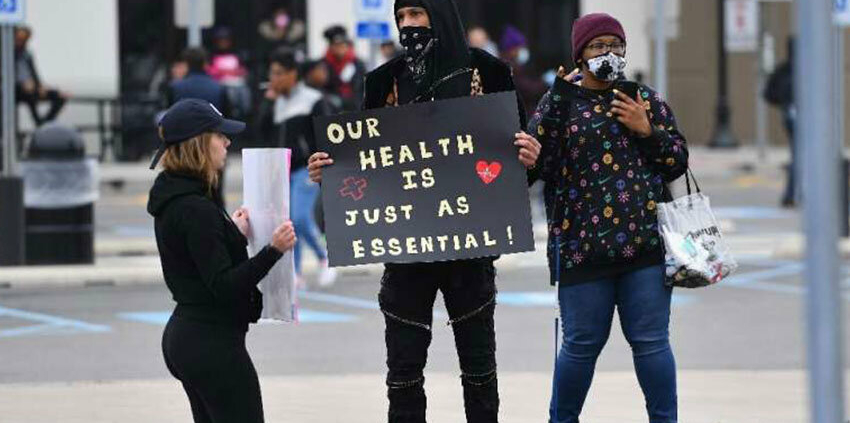
Workers demonstrating.

Workers demonstrating.

Most significantly, O’Brien described the holiness of Henry Dobbins carrying food for others. Who are among the holiest people in our pandemic world? I am reminded of the service workers, the people who shelve, package, and deliver food for our sakes. Just as they carry boxes for delivery, they also carry our sense of security in their dutiful hands. While doing so, many are risking their own lives. These workers show up at the supermarkets and drug stores each day prepared to serve like the priests of this weeks Torah reading.

Now it is our turn to do the carrying. What can you bring to others in this time of need? Will you volunteer to teach students whose school year is abbreviated? Or will you pack food for families in need? Are you calling people who may be shut in or isolated to lift the burden of loneliness?

As we emerge, slowly, from our quarantine, please consider the holiness of what has been carried to you and what you will carry for others in need.

Rabbi Evan J. Krame

We are uncomfortably stuck in a wilderness, a place of not knowing. Perhaps a good analogy is that I feel like we are in the Sinai desert. While we are most definitely not physically wandering, we have mobility in our personal journeys. I am comforted by the knowledge that growth often follows the wilderness experience.

In Hebrew, BaMidbar means “in the wilderness,” or “in the desert.” It is the name for the fourth book of the Torah which we begin reading this week.  The Israelite people were encamped in the wilderness by Mount Sinai for a year before traveling further.

At first the Hebrews were afraid of the unknown. Then they were awed by God’s magnificence. The Hebrews stumbled when they were sinful in creating the golden calf. Eventually, they were obedient in honoring and learning Torah. The journey from being slaves to being free is not a straight path. It requires a deep dive into the wilderness of your self to reassert your humanity. And we humans are not so easy to navigate!

I turn to an inspiring rabbi, Lawrence Kushner who wrote: “The wilderness is not just a desert through which we wandered for forty years.  It is a way of being. A place that demands being honest with yourself without regard to the cost in personal anxiety.  A place that demands being present with all of yourself. In the wilderness your possessions cannot surround you. Your preconceptions cannot protect you… You see the world as if for the first time.” (Honey from the Rock, 1990)


Books-That-Will-Help-You-in-Getting-Unstuck.jpg

In this Covid 19 wilderness, we are afraid of the pandemic. Physical sequestration can remind us to be in awe of the beauty of this world. We have sinfully worshipped our pot of gold. Some are learning a new Torah, to obediently shelter and to care for others in our community.

Zohar Va’era, 2:25b asserts that when we were in Egypt, we lost the ability to express our own stories. During that time, we were literally slaves to another person’s narrative.  When we left Egypt, we spent forty years in the midbar – the wilderness.  It was there that we began our national story telling and created our own identity. The midbar is a wilderness, but there is also a second meaning from the same word root — to speak — דבר. We went into the midbar to find our own voice and to write a new narrative as a people.

Our opportunity is to emerge from the Covid 19 wilderness with a new story. Here’s the story I’d like to tell. We learned to refocus on the precious nature of community. We began to elevate our neighbor’s needs over our individual privilege. Our compassion grew as we understood that minimum wage workers are essential to our sustenance and health care workers are warriors for saving lives. The story I’d like to tell is that we became a nation with a story that identifies us as patrons of humanity and protectors of our planet.

I am learning to unlock new truths in this wilderness of social distancing and staying at home. As if for the first time, I feel increasingly called to be an advocate for sustaining all of God’s creations. I hope we will all be guided by these principles: our nation should be a safe haven for everyone, a community of compassion, and a beacon of hope.

Not everyone will make it out of the wilderness. Some will not learn the new Torah. For those who get unstuck, let’s leave this wilderness together, better, stronger and spiritually realigned.

Rabbi Evan J. Krame


Fear is typically assumed to be a negative emotion. But not in Judaism. Even the standard biblical Hebrew word for fear is commonly translated as awe, not fear. I have been wondering how Jewish tradition can help me process (and decrease) my fear of an infinitesimally small and deadly virus.

Jewish texts recount many times filled with fear. Abraham feared for his safety when lodging in Egypt. The Israelites feared the onslaught of their Egyptian pursuers in the desert. Joshua was afraid before leading the people in battle. Fear is a constant throughout Jewish history.

Fear reported in our sacred texts was typically rebuffed by theological reassurance: take heart, have courage, and trust in the Lord. And what is to become of the panic, anxiety, worry and distress? The negative emotion should be redirected toward God, transforming fear into awe.

To complete the theological journey, fear is reinterpreted as the yin to wisdom’s yang. The formula for overcoming fear is spelled out by the texts. Fear of the Lord is the beginning of wisdom.” Proverbs 9:10. “Without fear there is no wisdom, without wisdom there is no fear.” Pirke Avot 3:21. Jewish thought transforms the negative emotion of fear into a first step toward knowledge and, subsequently, achievement.

Our goal is to transform negative energy into fuel for improvement. The road ahead is treacherous only for the faithless among us or for those whose journey does not take them from fear to wisdom. This admonition is given expression in parshat bekhukotai, read this week in Torah. We are warned that if we forsake God we will suffer such that we will live in fear. So fearful that we will be frightened even by the sound of a driven leaf.

We now live in a time where the sound of a driven leaf is frightening. What used to be ordinary has become daunting; like the proximity of a stranger walking on the street or the cleanliness of a door handle we touch. An invisible and seemingly unstoppable pathogen torments us daily. We can’t control the virus; only our own response.

All of us are fearful. Some will persevere. Some will suffer. The Jewish guidance endures. First, have awe and respect for the Creator and creation. Wake each day with a sense of wonder and gratitude. Second, don’t let your fear deplete your resolve. Rather, let fear be a reminder to pursue wisdom. Make sensible choices to protect yourself and protect the future for others.

The Jewish response, which is the response we need now, is to have hope and to make smart choices. And when this pandemic is over, may we be blessed to return to fearing less dire things – like being stuck in a traffic jam or developing new age spots. In fact, let’s remember to say a blessing the next time we are stuck in traffic or find a new age spot. They will remind us that our fear was temporary and our resolve was strong.

Rabbi Evan Krame

We can’t go back to “normal.”  The Covid-19 plague will abate but our society and nation will not go back to the old normal. Yes, we will live with inconvenient masks and gloves. But the next normal must be fundamentally and not merely sartorially different.


view from window.jpg

The time before the pandemic was actually abnormal say many progressives, channeling sentiments about inequality in America.  I am hoping for a “next normal,” guided by Torah. First let’s look at the problem.

In the past decade since the last economic crisis, wealth disparity metastasized. Before the pandemic, 69% of Americans said they had less than $1,000 in savings. More shockingly, about 45% said they have $0 in savings.  Most Americans are not profligate spenders. They are living paycheck to paycheck. And tens of millions just lost their jobs.

Before the pandemic, 28 million non-elderly people had no health insurance. Not surprisingly, people without insurance coverage have worse access to care than people who are insured. One in five uninsured adults in 2018 went without needed medical care due to cost.  In a time of pandemic we learn that all should receive both preventative and continuous health care. And many unemployed people just lost their health insurance.

Before the pandemic, 40 million Americans including 12.5 million children faced food insecurity and hunger every day in America. Food banks are strapped while farmers are dumping tons of food. More people are going to bed hungry tonight.

So, what does it mean to go back to normal? Normal was millions of Americans with no financial cushion, no health care, and not enough food.  Is that the America we wish to resurrect?

In Torah this week, parshat Emor, we are reminded not to reap all the way to the edges of our fields, or gather the missed gleanings of our harvest; but to leave them for the poor and the stranger. Why? Because the LORD is your God. So important is this precept that it is stated twice in Leviticus. Holiness is taking care of every person in financial distress, even if unknown to us.

We must now follow this teaching, create a next normal modeled on Torah. The next normal should be a world in which we promote democratic and free market principals while promoting a living wage for all, universal health insurance, and the elimination of hunger. That’s what Torah demands. It doesn’t demand that the farmer disinvest herself of her fields and transfer them to those who are landless. Torah demands that we share sufficiently to keep all people in our country safe, healthy and fed. 

The Government just proved we could do this. Our nation can afford to provide health care, support a living wage and feed every person. And it will cost less than bailing out big businesses yet again, twice within a dozen years. 

We anxiously wait for that time when we emerge from our physical confinement to fully reengage in the next normal society. In the meantime, we can prepare ourselves spiritually for the Torah inspired country that we should be.

Rabbi Evan J. Krame
 

After shutting down much of the economy, society and religious activity in the wake of the Corona virus, we anxiously await that “morning after.” How will economic, social and spiritual life resume? Of course, Torah has a suggestion about how we reengage as a community.


hazmat.jpg

After the sudden death of Aaron’s two oldest sons, Acharei Mot (after death), there was a period of isolation and mourning. Then Aaron returned to his priestly duties. He bathed thoroughly, he got dressed carefully, he performed his duties in a singular fashion, followed God’s rules, and he went about his life purposefully.

The chance that death could strike again must have haunted Aaron and others in the priestly clan. We too are worried about COVID-19. Eventually, we will venture out and return to our societal roles. Mostly we will be more careful:  wash often, don masks, maintain distance, follow the rules as if in holy pursuit.

The current approach to the pandemic has been subject to criticism.  On March 20, 2020, Dr. David Katz wrote in the New York Times: “I am deeply concerned that the social, economic and public health consequences of this near total meltdown of normal life — schools and businesses closed, gatherings banned — will be long-lasting and calamitous, possibly graver than the direct toll of the virus itself.” He continued: “I believe we may be ineffectively fighting the contagion even as we are causing economic collapse.”  His solution is “a pivot right now from trying to protect all people to focusing on the most vulnerable.” He concluded: “The path we are on may well lead to uncontained viral contagion and monumental collateral damage to our society and economy. A more surgical approach is what we need.”

While Dr. Katz’s position has been scrutinized from a scientific and political stance, there are also moral issues to be addressed. Jewish teaching contradictory to Dr. Katz’s op-ed is that every life is as precious as an entire universe (Sanhedrin 37a). Can we honor that principal even as we reenter and expose society to this illness and possible death? How do we heed Dr. Katz’s warnings as Jews who cherish every life as precious?


jews across brooklyn.jpg

I believe that our moral response begins here: “all of Israel is responsible for one another” Kol Yisrael arevim zeh bazeh” (BT Sh’vuot 39a). Our obligation to each other is unlimited in scope and time. That reciprocal obligation runs between sick and healthy, young and old, powerful and downtrodden, Jews and non-Jews. Our moral duties go not only to protecting lives but also to the quality of lives for the entire community, now and in the future. There are competing principals in play.

From the Jewish perspective the covenantal relationship that gives rise to communitarianism often takes precedence over individual rights. Rashi wrote that the people Israel, as a collective, beats with one heart (not thirteen million hearts). The collective and interpersonal engagement is fundamental to Judaism. The Talmud teaches: O havruta o mituta: “give me fellowship, or give me death” (BT Ta’anit 23a).

And we stand (nitzavim) in this moment as representative of generations past and those to come. To the extent we don’t get this right, the children and their children will suffer the sins of their parents. Leviticus 26:29. 

In these principals, Dr. Katz’s op ed pieces does not stray far from Torah. 

Which view governs? The Talmud suggests both; Eilu v’eilu divrei Elohim chayim — “these and these are words of a living God.” How do we morally uphold a communitarian approach when the consequences are at odds with individual rights and protecting lives? In response, and most frustratingly, we have just one certainty; there is no absolute moral clarity. There is no single Jewish approach to reopening society during a pandemic.

I take direction in this moment from Aaron. He must have felt great uncertainty continuing the work of the priesthood after his two oldest sons were suddenly killed in that very line of work.  Aaron had to psychologically and theologically cede some measure of control to God’s providence, whether it seemed good or bad. And Aaron took precautions. He washed, he dressed carefully, and he followed rules as he reengaged with the world.

As we learn in “Pirkei Avot: It is not your responsibility to finish the work, but neither are you free to desist from it.” Those are our marching orders for this time of contagion. Be like Aaron: do not desist from the work but be careful as you reenter this world, and do so in holy pursuits.

Rabbi Evan J. Krame
The current COVID-19 pandemic is not the first instance in history of a plague. And social distancing is not new as a response. In our tradition, illness sometimes required isolation. What one did with that isolation was the key to a cure.

In this week’s Torah reading, Tazriah-Metzorah the Priests passed judgment on a skin disease that was later referred to as leprosy. There was no medical remedy available. The ill person was put in isolation. Sound familiar? 

These verses beg another question. It seems that, in the absence of doctors, the religious leaders, the priests, took on a health care role. There were no pharmaceuticals in their arsenal. Yet, the priests were likely more concerned with spiritual fitness than medical cures. Applying ancient theological praxis, if one was afflicted then that person must have been engaged in some iniquitous behavior.

The treatment prescribed was separation. Seven days outside of the community and then reexamination.  If the skin eruption had not healed, then seven more days apart was required.

Perhaps, however, we could change the equation. Rather than presume that spiritual lack causes illness, what if our spiritual health supports our ability to cope with illness?

Today many find prolonged separation from community to be unhealthy. Most people crave some companionship and touch. Mental health suffers from isolation – disrupted sleep, depression and altered eating habits.


alphonse-osbert-au-coucher-du-soleil-285x190.jpg

On the other hand, there have always been monastic traditions of prolonged separation and even silence as a spiritual exercise. Therefore, both separation as causative and separation as curative are correct. The distinction is our ability to strengthen our soul force while in separation. Certainly, the priests thought that separation was key to restoring spiritual well-being, and spiritual health would bring physical healing.

While hunkering down, we can engage in exercises that will improve our spiritual and therefore physical and mental health. Now is a good time to figure out a spiritual practice that will work for you. Meditation, yoga, torah study, or prayer are always available to you. Perhaps these spiritual modalities will best help you, not only to endure but to thrive. 

My spiritual practice is Talmud study. What spiritual practice best suits your time in seclusion?

R’ Evan J. Krame

As an unexpected exercise in binge television viewing, I watched The Leftovers. The HBO series explored the psycho-spiritual reaction to being a survivor after 2% of the world disappears. The reactions ranged from deepened faith to a rejection of all societal norms. While we cope with the ravages of Covid – 19, I considered the role of survivors from a Jewish lens.

In parshat Shemini, and at Leviticus 10, the two older sons of Aaron died suddenly when offering “strange fire.” The story then turned to the actions of Aaron, the grieving father, and the two younger brothers, Eleazar and Ithamar.  They are referred to twice as the remaining sons. As “the Leftovers” they rejiggered rituals to meet the new circumstances. 

Moses, keeper of the faith, angrily questions how the remaining sons handled the daily sacrifice. With Aaron’s explanation, the rule for consuming the sacrifice was amended in case of death.

We are in such a transitional moment. Our primary role is to stay cloistered. Yet, merely sheltering is insufficient. Perhaps it is time to also consider how this pandemic may change our Jewish rituals.

How will we grieve our losses? How will we reenter civil society? How will we engage spiritually? And how will the old leadership (i.e. Moses’ role) react to the newly adjusted norms?


On line life cycle event.

On line life cycle event.

For example, the use of Zoom and Facebook has adjusted the way we gather and worship. Either we can return to prayer spaces (or supporting synagogues while going to the gym instead) or we can build on these virtual ways of connecting in spiritual community. These on-line platforms provide easy access and together we reduced air pollution!

Life cycle events have also continued in new, limited yet meaningful fashion. Distance weddings and virtual funerals are redefining how we ritualize life cycle events. As to the celebration of holidays, our on-line Seders allowed us to reach more people with greater ease even while some lament the distance between family members, And with less people traveling we honored the environment and gave the earth more breathing room. 

In the post-Covid 19 world, we will reevaluate the accouterments of religious life. There may be opportunities to deepen our faith engaging in new-ish modalities and selecting from a modern spiritual toolbox. Rather than see ourselves as merely “the leftovers” we can be the change agents of a more potent faith construct for this modern age. 

R’ Evan J. Krame