
The movie Gone with the Wind has recently sparked controversy.  The 80-year-old film depicting slavery and racism in the South was previously considered a masterpiece of cinema. Now it is at the heart of a debate about whether the movie should be viewed ever again. I am here to argue to include GWTW in our movie repertoire.

Also of note in the news is that Olivia de Haviland, who played the painfully sincere Miss Melly, died at the age of 104. It was her character of Miss Melly that inspires viewers and deserves to be seen again and again.

As you may recall, the scheming Scarlett O’Hara of the Tara plantation and the rapacious Captain Butler who supplies the Confederacy are the films’ lead characters. Miss Melly is a moral grounding for the story. She demonstrates loyalty, caring and optimism in the face of duplicity, greed and destruction.

If cancel culture bans Gone with the Wind to the ash heap of movies, we lose the story of Miss Melly. Few movie characters of the golden age are as wholehearted; good for the sake of being good. If any character of Gone with the Wind embodies Torah values it is she.

At parshat Shoftim, we learn “You must be wholehearted with the Lord your God.” Wholeheartedness is committed, positive, devoted, and dedicated. How can one be wholehearted with God? By being the best person we can be even when no other person is looking. While no other person may be in view, we should always act as if God is watching.

Cancel culture would ban Gone with the Wind. If that happens, we lose the story of the wholehearted woman who sits at the moral fulcrum in a world literally burning and crumbling around her.  Sometimes the stories that best inspire and instruct are couched in a story of avarice and self-interest.

As the High Holidays approach, we are poised to find the moral fulcrum of our lives. We are guided to act wholeheartedly under the presumption that God is watching.  And we learn that cancel culture does not help us to redeem the virtues that sustain the world. The Jewish approach is to seek and embody goodness even when all seems to be collapsing around us, just like Miss Melly.

Evan J. Krame

The Staple Singers reached number one in 1972 with their hit, “I’ll take you there.” I remembered this song while reading through Deuteronomy! The final book of the Torah recalls Moses’ leadership, taking the Hebrews to the edge of the Promised Land. For Forty years, Moses reminded the people that God would take them there.

“I’ll take you there”, the song, offers the hope of an Edenic locale where “ain’t no body crying, ain’t nobody worried.” The song contrasts the promised land with the harsh reality of the African American experience. The lyrics describe that heavenly place with “no more smilin’ faces lyin’ to the races.”

How can we get to a place without strife and oppression? Lead singer Mavis Staples calls out, “somebody help me now.” The chorus responds, “I’ll take you there.” The song teaches that it takes a partnership for us to reach a better place. Moses offered the same lesson.

As a storytelling device, Deuteronomy anticipates crossing over into a promised land. Moses has brought the people to the doorstep. But he did not enter the land with them. Moses recognized the need for caring relationships and collaboration among the people. He advised them to subsume their egotism to the greater good. In parshat Re’eh (See!) Moses adjourns the people:

לֹ֣א תַעֲשׂ֔וּן כְּ֠כֹל אֲשֶׁ֨ר אֲנַ֧חְנוּ עֹשִׂ֛ים פֹּ֖ה הַיּ֑וֹם אִ֖ישׁ כָּל־הַיָּשָׁ֥ר בְּעֵינָֽיו

“You shall not act at all as we now act here, every person as they please, . . . “

The essence of Judaism, for me, is the focus on relationships rather than the individual. We are created to be helpmates to one another. If one calls out for help, others respond with chesed (loving-kindness). We pray as a minyan. We are encouraged to learn in pairs, as chevruta. We can envision a better future individually but realize a paradise only when we act collectively.

If we retreat into our own self-interest, Jewish ideals are not realized. When we act as we please, the entire world suffers. When selfishness masquerades as freedom, everyone suffers.

Judaism’s communitarianism has lessons for these times. We wear a mask to protect others. Israel offers aid to Lebanon in response to a Beirut explosion. Jewish Americans advocate for African Americans. Our religion puts forth the value of reaching out that makes a society civil.

We all know that this country can improve. There does not have to be hungry children, foul water, and choking smog. Economic gain only for the upper classes will destabilize our society. The government can promote and support advancement, rather than advocate self-interest. Nothing cannot take precedence over respect for life.

Like the song “I’ll take you there”, we need a call and response approach to life. If one person calls for help others should extend a hand. When we devote ourselves to each other rather than each doing as we please, we will arrive at the Promised Land, together.

Evan J. Krame

Do you still have nightmares about missing a test in school? Or failing out of a class? Amazing how these school time traumas continue to haunt us so many years later. Preparing for school exams was a traumatic test by itself. Now imagine if you had to cram for a test not of your knowledge but of your character.

The current pandemic is a test of our character. Torah stories support that understanding. God set us free from Egypt only to set us wandering in the wilderness for 40 years. Moses tells the people at parshat Eikev this week, it was all a test of what was in the peoples’ hearts. The purpose of the test was to help build a nation dedicated to spreading godliness in the world.

What is in my heart today is a jumble of responsibility and guilt avoidance, empathy and self-protection, emotion and rationalization. What matters, according to Moses, is that our hearts are perfected by any challenging experience. Tests of our character will occur throughout our lives. Torah asks that we improve because of the challenges and not backslide into self-wallowing pity.

Some may redirect their angst and displeasure by blaming God. Why would God create such terrible tests? We humans can’t answer that question. What we can fathom is how we respond to the challenges. That is the exam that I believe God puts before us. In Torah language, our hearts should be “circumcised” by the most difficult experiences to peel away the callousness of self-interest and reveal the soft-heartedness of true regard for other people? Will we pass the test of this pandemic?

Only some individuals are physically sick, but collectively we are all sick at heart. Our hearts should beat with pride in our country, faith in our institutions, and devotion to the rights of all free people. Our hearts should be filled with the satisfaction that we nurture future generations with educational opportunities, advanced health care, and stimulating arts.

Instead, we are being tested like the Hebrews wandering 40 years in the wilderness. God remains watchful, but our travails do not end until our hearts answer this test with a dedication to improving relationships, rebuilding society, and restoring freedoms.

I hate this virus and the wake of devastation it has caused. But I am hopeful that the aftermath will be a nation guided by goodness, generosity, caring, commitment, and love. May these be the correct answers to the test and bring an end to this nightmare.

Rabbi Evan J. Krame

Italians are known for their carefree and willful spirit.  When the pandemic hit Italy early and hard, commentators wondered if the Italian people could abide a lockdown. They did. The “plague” abated.

Americans aren’t so different in temperament from Italians. Yet here in the United States, we could not even agree upon a lockdown. It is hard enough to follow instructions, but the situation is much gloomier when there are no instructions. And yet, Jews have known the instructions all along.

As Moses readied the Hebrew people for entry into the Promised Land, he admonished them “give heed to the laws and rules that I am instructing you to observe, so that you may live to enter and occupy the land that the Lord, the God of your ancestors, is giving you. You shall not add anything to what I command you or take away anything from it . . .”  The detailed instructions of the Torah were not so simple.  But the principles to follow were clear – value life, don’t act wickedly, love.

The covenant made at Sinai was made with every one of us living today. Honor God, you are NOT God, don’t idolize, don’t curse God’s name, rest each week, honor your parents, don’t murder, don’t commit adultery, don’t steal, don’t lie and don’t covet.

And when your children and their children ask what happened that caused us to spend 2020 cowering and suffering from a pandemic, you might answer, we forgot how to follow the instructions. We should not have needed a President to tell us how to behave. We already knew how to behave:  value life, don’t act wickedly, love.

We didn’t listen, and we didn’t abide by what is holy. We were willful. We idolized our individualism. We worked so hard, we never really rested. We didn’t honor our ancestors. We let less advantaged people die, we adulterated the planet, we increased wealth disproportionately, we lied to ourselves, and we lusted for more.

Is the Jewish religion relevant to our times? It certainly is if people will follow the instructions.

Rabbi Evan J. Krame

The key to staying sane in the coming year is to find a sense of freedom even when confined. We can do that with some orderliness and control. That’s the best way through to the other side.

The path to a promised land is always by way of a narrow and perilous path. Upon leaving Egypt the Hebrews passed through the sea of reeds, with walls of water to their left and right. To complete the journey, forty years later, they passed through lands inhabited by hostile nations. Moses sends out word, seeking permission to traverse the land.  “Let me pass through your country. I will keep strictly to the highway, turning off neither to the right nor to the left.” Emerging from a confined passage, be it through land or time, requires that we be forward looking and not distracted by the dangers on the left or right.

The dangers these days are not so much from hostile neighbors so much as a devastating virus.  Many are struggling to find meaningful activities in their days when days seem to blend one into another.

I am not trained to address the psychological challenges. I would offer thoughts about the spiritual challenges. Try having faith. Faith is expressed when we plan for a day that we can move in any direction.  Faith is fostered when we extend ourselves to others who are struggling. Faith is nourished when we make a spiritual practice part of our daily routine.

Add some orderliness to your day with an exercise routine or a long-term study project.  The internet is rich with classes like yoga and torah study. Demonstrate control over your day by following a schedule and checking off a list of tasks completed. Reach beyond yourself. How ever much you feel constrained, there are many far more impaired. Spread your love and concern. How about a weekly email or text every Friday wishing individual friends and family a Shabbat shalom?

Torah urges us to focus our attention toward the future. Our goal is to pass through to a promised land.  The trip is not without danger but the reward at the end may be paradise.

Rabbi Evan J. Krame

We have been startled by the murder of African Americans who are victims of police brutality.  In years past, the offending Police Officer might have found refuge from prosecution.  The union, the municipality and white society offered protection to the offending officer. They argued that we can’t afford to disempower the police. Those in power argued that society is better off tolerating some abuses for the overall suppression of criminal behavior.  

There is a Jewish perspective that elucidates the need for a counterargument. Near the end of Bamidbar, the book of Numbers, the pursuit of a murderer is considered. When loss of life is due to accident or the result of an argument, the perpetrator could flee to a city of refuge. Six cities of refuge existed to protect the manslayer from the revenge of the victim’s family.  However, when the act was intentional, Torah says that the victim’s blood not only cries out for justice but also pollutes the land.

A role of religion is to reframe events to reveal their spiritual meaning. Whenever someone is murdered, a life is ended, and the world suffers a loss. Whether the taking of a life happens by the hand of a police officer or a parolee, the result is that the entire land is corrupted. Attempts to excuse murder or to rebalance justice, is made more difficult when the entirety of our land is understood to be defiled. 


scales tipped.jpg

We understand the need for justice to sustain a civil society. But justice needs to reflect more than basic truths. Justice requires a grounding in morality. Torah adds that perspective stating that the land is defiled. By land, Torah does not merely mean a defined patch of earth. The land is the earthly home for divinity to reside. While Torah contemplated only the land of Israel as God’s home, later generations would say that God resides anywhere we allow God in. The text asks us to comprehend the defilement caused by a criminal act. The crime is not merely between two people and not limited to an abstract concept of justice. Murder renders the land in which we reside unworthy of God’s presence.

For me, the role of Judaism as a religion begins with an unwavering appreciation of human life. We start our journey being created in God’s image and we are asked to live our lives creating a world worthy of God’s presence. When we regard all violent deaths as a defilement of God’s place, society might better appreciate the need to make fewer excuses and offer greater protections.

Rabbi Evan J. Krame

When listening to a stimulating story, a child may hasten the tale’s end by asking “and then what happened?” In these times, I feel like every day is a “then what happened sort of day.” The story of our times is grueling. Being perpetually careful is fatiguing. Being tired is exhausting (anyone else having disrupted sleep?). Yet, it is most important that we anticipate the future . . . especially when it feels like we are getting swallowed up by the present.

I was thinking about another crisis that swallowed people up. A short while ago, we read in the Torah cycle about Korach’s rebellion. In response to a revolt by priestly families, the earth opened up and swallowed 250 of the challengers including Korach.  Chapters later, in Parshat Pinchas, we learn that Korach’s sons did not die with their father. Korach’s descendants kept their place in the religious life of the Jewish people. In fact, eleven of the psalms were attributed to Korach’s offspring.

The story of Korach’s heirs gives me hope. Theirs is a story of future generations, the descendants of rebels, who sustain a righteous path. Theirs is a story proving that the children can transcend the mistakes of their parents.

These descendants of a rebel wrote beautiful psalms, speaking of overcoming their own despair. They placed their faith in God. They wrote “Why so downcast, my soul, why disquieted within me? Have hope in God.” Psalm 42.

Many of us feel downcast and disquiet.  I overcome despair with hope. For me, hope is the faith that God has set into motion all of the healing, all of the repair, and all of the sustenance we need. My faith in people is not always so steadfast, although my confidence in future generations is more resolute.  As the descendants of Korach wrote:

תַּ֣חַת אֲ֭בֹתֶיךָ יִהְי֣וּ בָנֶ֑יךָ תְּשִׁיתֵ֥מוֹ לְ֝שָׂרִ֗ים בְּכָל־הָאָֽרֶץ׃

Your children will succeed your ancestors; you will appoint them ministers throughout the land.

We need healing; a vaccine, a just society, and a healthy planet. I believe that cures will be developed, civil rights laws will be passed and the environment will be improved. I believe that healing will come as today’s children and grandchildren become the ministers of the future.

We have not respected the science, the morality and the planet. We focused on personal freedom without prioritizing social responsibility. We focused on personal success without prioritizing civic responsibility. We focused on personal comforts without prioritizing environmental responsibility. But our failings are not the end of the story.

When the story of these times is told the children will question: “and then what happened?” I believe that the answer will be that the sons and daughters prevented plague, secured justice, and saved the planet.

Rabbi Evan J. Krame

Those who expect an easy victory in a climate of complacency are going to be disappointed. Whether it is our reliance on medical professionals and scientists to rescue us, or on politicians to correct injustice, some have forgotten that all are a part of the solution of our challenges. We begin by lifting up our voices. We achieve success through cooperation. We complete the task with faith.

This week in Torah, the wandering Hebrews needed water. God told Moses to assemble the people at Be’er. God said – “so that I might give them water. וְאֶתְּנָ֥ה לָהֶ֖ם מָֽיִם”  Note that God directed Moses to bring the people to a place called Be’er which literally means well! The people sang a song – “spring up O well”. Then the nobles loosened the earth and the chieftains dug it out. Water sprang up.

The leadership listened to the song of the people and undertook the task. The precursor to success was the encouragement of prayerful singing. Then, in a combined effort, the tribal heads provided relief through collaboration. While the water was already there, success came only when the leadership pulled together to complete the task. What a model for our time! Together the Hebrews transformed parched to pouring.

The progression of the story itself is uplifting. The people next continued their travels toward Canaan from the Midbar (wilderness) to Matanah (a gift) to Nahaliel (an inheritance from God) to Bamoth (high places). With song, cooperation and faith they moved from the wilderness to a holy place.

Torah reminds us that God is the source of life. With that faith, we transform what might appear to be a mere gift into an inheritance from God. Holiness is understanding blessings as inheritances from God. Our role in bringing down holiness begins by uplifting our voices. It continues with collaboration and reaches completion with awareness that the source of our rescue is Divine. Then we return to song; hallelujah!

The prayer songs of today are songs of hope for a cure, justice for all people and healing for the planet. After the singing comes cooperation which is the way to quench thirst in the droughts of our time – a vaccine for Covid 19, justice for all people, and saving the environment. We need more cooperation to overcome the plagues of our day.

Whether your role is to sing out in prayer, enable the responders, or heal our world, each of us should act in recognition that we can always be partners with God.  After all, the well provided by God has always been there!

Keep singing and believing friends, especially until the election in November.

Rabbi Evan J. Krame

The plague started before awareness gave way to authenticity. Being oblivious was excusable for a while. There was so much disruption; so many distractions and so much discord. Nothing seemed normal. People felt lost. But plagues spread when we are defiant and ego-centric. And the plague spread quickly.

This was the story of Parshat Korach, a plague that occurred in a time of upheaval.

Before the plague began, there was the rebellion of Korach and his men. Elite families of the Levite tribe challenged the religious order. Oddly, those same Levites benefitted from these systemic advantages. Why were they not satisfied with their privilege? They were already God’s anointed.

Disregarding process and craving power, tribal divisions became rivalries. As a result, faith in leadership was shaken. Governance was broken.

And this is a story for our time as well.

Moses was faithful and resolute. At God’s instruction Moses ordered the rebels “bring your fire-pans and incense tomorrow.” In the morning, the insurgents failed the test. God sent a miracle. The earth swallowed them up alive, they and their families, 250 in all.

After Korach and his men were lost, some were horrorstruck and others were defiant. Miracles were supposed to rescue us. Miracles were not to destroy us! 250 people lost in a gaping hole. Men and women with their children consumed alive. How could this be? The hole had barely closed up before a plague began.

With a fire-pan and incense, Aaron ran through the crowds to stop the plague. This time fourteen thousand and seven hundred died. This plague killed quickly and effortlessly.

Some victims of the plague were those who held on to the acrimony fueled by Korach’s rebellion. They had not learned the lessons of how to respectfully enter into dialogue. Their rebellion was feckless. Many innocents died along with the malcontents. The implacable ones brought blameless ones down into the ground with them.

Plagues punished indiscriminately. They spread wantonly. They spread through our own recklessness. They spread due to faithlessness.

We also have been self-important, vainglorious. The Covid-19 plague has chastened some of us. Torah reminds us that the greatest leader, Moses, was the humblest of men. Humility is essential to successful leadership, especially in a time of plague. Such is the leadership we need today. Torah reminds us that a leader is responsible to the people. When Moses descended Sinai after receiving the tablets in a second trip, his face shined brightly. He veiled himself so as not to harm others. Humility keeps masks on faces.

There are many kinds of plagues. Some plagues are illnesses. Some plagues are societal. Some plagues began long ago. Some plagues are latent.  All are toxic. Occasionally a plague becomes active, catching us unprepared. But we’ve suffered plagues before. Can we really claim lack of awareness to any plague? At least we should remember to be humble and responsible.

Now we are left wondering, what fire-pan of incense will stop this plague? What leadership will run among the people in rescue? Will we learn the lessons before the next plague starts? To contain a plague requires obedience and humility.

Rabbi Evan Krame

A time of crisis gives us new eyes to see truths hidden in plain sight. It took a pandemic to alert us to a failed public health system and racial injustice. It took the protests responding to the death of George Floyd and countless others to gear up America for systemic change.  Why weren’t our eyes opened to these truths before?

Torah cautioned us about our inability to truly see. Parsha Shlach opens with Moses sending a dozen spies to the land of Canaan. Ten report their terror at the giants that inhabit the land. Only two, Joshua and Caleb, are able to see the true picture. Ten spies operated from a paradigm of doubt. Two were activated by faith.

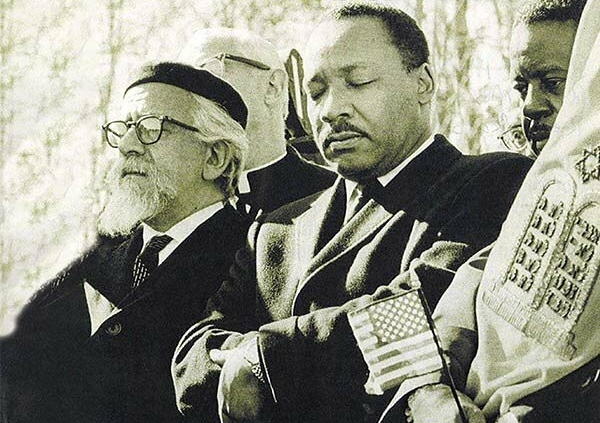
Until now many of us have been like the ten spies. We’ve been blinded by fear of change while protecting our turf. The status quo, even though set in a wilderness of racial injustice, has seemed sufficient. Change is scary.  But those religious leaders who could see the Promised Land, Martin Luther King and Abraham Joshua Heschel, had faith. As with the Jews in the desert, even leaders of great faith could only move this nation partway along the path when so many were willing to be blind to the truth. 


Rabbi Heschel and Dr. King.

Rabbi Heschel and Dr. King.

We have wandered as a nation for more than 40 years since the Civil Rights movement prime of the 1960s.  Now 60 years hence, voter suppression, unrelenting poverty, and police brutality remain. We’ve wandered long enough in this wilderness. Americans of color have suffered enough. The generations of the confederacy and the epochs of bigotry should have “died out” by now. 

For those Jews who feel detached from the urgency of repairing racial injustice, I offer these thoughts – none are novel. Jews became “white folks” as overt anti-Semitism retreated and Jews took commanding roles in various industries across America. Our alienation, if you will our “blackness”, is diminished but for episodic confrontations with anti-Semitism. If we have benefitted from the educational systems and economic engines of America, Jews have done so with the assistance if not at the expense of people of color who lived and worked in a way to support our endeavors. 

Shabbat 54b teaches that we have an obligation to protest. Our obligations don’t end there. Leviticus 19:16 says “Do not stand by the blood of your fellow.” We are reminded that when Cain killed Abel, the bloods (plural) of Abel called out. This is to teach us that the destructive and calumnious behaviors of the past call out for generations. The blood of George Floyd calls out to us for action today.

I cannot speak of the moral imperative any better than two giants of Jewish thought of the 20th Century so I leave you with their brilliance as an exhortation to each of us to move America from the wilderness into the promised land. As the story of the spies teaches us, see the future with faith not fear.

“…morally speaking, there is no limit to the concern one must feel for the suffering of human beings, that indifference to evil is worse than evil itself, that in a free society, some are guilty, but all are responsible.” –Rabbi Abraham Joshua Heschel

“Being human means being conscious and being responsible. By becoming responsible agents for social change we actualize not only our humanity but also our mission as Jews.” Viktor Frankl

Rabbi Evan J. Krame