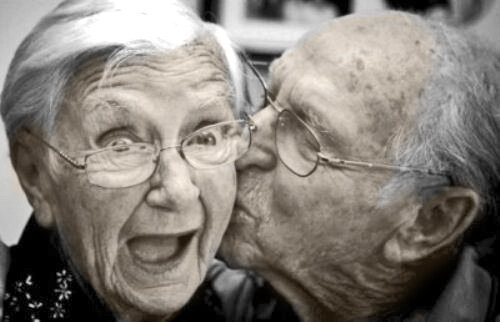
Roz was due to have lunch with her friend. That morning Roz learned that her friend had to attend a funeral which would delay lunch. Roz offered to attend the funeral as well. Why not? It was a sunny day in Florida and the cemetery wasn’t far from a good restaurant.

At the graveside, Roz greeted the mourning husband with offers of condolences. He took her hand gently, acknowledging her sentiment. They were married six months later.  As God said with regard to Adam, it is not good for man to be alone.

Men are very likely to remarry after their wife dies. When I talk to couples about end of life planning, I gently suggest to the wife that if she dies first her surviving husband is likely to remarry and soon.  I often joke that this proves how weak men really are, less likely to thrive alone.

In Torah, Sarah dies and Abraham the centenarian remarries Keturah. Perhaps to make it less seemly, rabbis of later ages will suggest that Keturah was really Abraham’s first consort, Hagar.  In any case, Abraham who was thought by Sarah to be told old to be father to Isaac will now sire six more children.

The desire for progeny was the theme of many chapters in the story of Abraham and Sarah. Perhaps that goal remained significant in Abraham’s mind. Yet, I am disquieted when I read that Abraham remarried. I want Torah to tell us a great love story of a broken-hearted Abraham, grieving for his wife and remaining alone with his sorrow.  My romanticism is unrequited for all eternity.

We can love again after loss. We may even be able to create more life. Old age offers possibilities, but the expiration dates may be just a bit sooner than we would like.

Rabbi Evan J. Krame

Election fever is upon us. There is no aspirin to reduce temperature. The infections of partisanship and arrogance have long festered and are likely to persist. Are we going to shut ourselves in or work these problems out?

Jewish tradition offers two critical instructions. The first is to set aside one’s anger. The second is to engage with our opponents.

I feel anger at the many who do not understand politics the way I do. The challenge for me is to sustain my truth without resentment and ire. As we are taught in Talmud, “anger will cause a sage to lose his wisdom . . .” (Pesachim 66b) and “One who is angry does not even consider the presence of God important.“ (Nedarim 22b).

Anger distances us from the Divine. This is the example of Abraham. He has many reasons to be angry and opportunities to demonstrate his anger. Rather, he demonstrates restraint because of his love for God.

In parshat Vaera, Abraham confronts Abimelech over the well at Beer-sheva. Abimelech’s servants had seized a well that Abraham had opened. This is no small matter. Water is essential and Beer-sheva geographically lies at the edge of the Negev desert. Abimelech denies knowledge.

Abimelech is Abraham’s neighbor. Each man has resources and power. Abraham could have challenged Abimelech’s denial with righteous anger and a show of force. Yet, Abraham resolves the problem without pique.

Abraham offers a pact, securing ownership of the wells. Abimelech accepts. Then Abraham plants a tamarisk tree as an acknowledgment of God.

While they could have been in conflict, they choose a path of co-existence.  This is our instruction for life post-election. Adversaries can co-exist without acrimony and anger.

I have been stuck in my rage over the current administration’s policies.  At times I am incensed by contrary opinions on environmental action, civil rights, or wealth disparities. The problem is that anger only serves to distance us from family and friends. Yet, after the winners are declared in the Presidential election, we should open hearts and (symbolically) extend hands. The success of this American experiment may depend upon our application of Abraham’s example of coexistence.

Rabbi Evan J. Krame

Each October, we make a point of a weekend trip to view the changing leaves. We marvel at the red, yellow and ochre brush strokes on the Appalachian hillsides.  Inevitably we debate whether or trip was too early for peak or too late to view the height of color. What a metaphor for our lives, not knowing if the crescendo of our lives lies before or after we take notice.

Talk of retirement and aging in place are common conversations among our friends.  These discussions make me feel like the peak has passed and we are just waiting for the leaves to fall. But then I remember the trajectory of my life, adding career upon career, and an evolving world view that feels more mature and holy. Perhaps the peak colors of my life are on the horizon.

My Hebrew name, Abraham, reminds me that I am the namesake of our first father. Abraham left his home in Ur and travelled to Canaan while in his 80s.  His children arrived while in his 90s.  And he added a few more when he was well past 100.  Now I am not advocating for centenarian fatherhood.  I am noticing that when God promised him the legacy of a nation of descendants, Abraham argued that the possibility of fatherhood was behind him.

Torah teaches that we should not bury possibility. Rather, we are to have faith in the opportunities to create and experience new worlds. Faith is not a sit on your tuchas concept in Judaism. Faith is proactive.  Faith is hiking a trail to see the next vista.  Faith is taking the next step even if you feel tired.  Faith is the path of possibility and self-actualization.

When is the right time of year to view the colorful leaves? The right time of year to view the leaves is whatever day you drive your life to the forest and hike those trails. Whatever the colors, if you hike long enough, you may find the colors you seek. And have faith, that the leaves will emerge green again.

Rabbi Evan J. Krame

The first time I was drunk was at a New Year’s Eve party. In the spirit of the celebration, I imbibed a few too many Harvey Wallbangers.  (For those under 50 see Wikipedia). The evening included some embarrassing activities. I was pleased that no one made much of  a fuss over my sloppy insobriety.

Which brings me to this week’s Torah reading. The story of Noah includes a boat building project and a sea voyage. The Noah story comes to a close when the yield of a vineyard leads to Noah’s inebriation. Sampling the wine, Noah, while in his tent, becomes intoxicated. This drunken 600-year-old man was found naked and alone.

Ham espies his father’s condition and alerts brothers Shem and Japheth who were outside of the tent. Ham does nothing to help. In the first ever “cover up”, brothers Shem and Japheth covered their father’s nakedness. They turned their backs toward him and led Noah to a dignified rest within his tent. When Noah awoke the next day, he learned of the past evening’s events and cursed his son Ham.

Context is instructive. Noah has outlived every other person of his generation. He rescued all species of animals from the flood. Noah was worthy, resolute and unassailable. In a moment of weakness, Noah drank too much. Perhaps he misjudged his tolerance level. As for the clothes drop, note that Noah was in his own tent at the time.

Noah cursed Ham, the son who discovered his father’s inebriation. Ham didn’t cover his father’s nakedness. Ham embarrassed his father, telling his brothers that daddy is sloshed. Ham’s intentions were neither respectful nor honorable. Had he been concerned for his father, he would have covered Noah immediately. The episode calls Ham’s character into question.

Many of us have behaved poorly in an altered state of mind whether induced by wine, pills or weed. How others respond is Torah’s concern in the final chapter of Noah’s story. And the Torah’s focus is an important lesson for our times.

We live in an era where shaming other people is both sport and entertainment. Powerful people try to gain advantage by calling attention to the errors of their rivals. Television news offers expansive coverage on the foibles of public figures. Does anyone remember much about Wilbur Mills other than his driving drunk into the Tidal Basin with a stripper? As we focus on the drunk history of our public figures, we often disregard their talents and contributions.

To end this era of gossip as news, we can begin by recalling Ham’s distasteful treatment of his father. We can demonstrate appropriate behavior by upholding standards of respect and caring. We should not achieve personal gain by calling attention to inappropriate but forgivable behaviors. As Noah called out Ham, we too should speak against harmful disparagements because little good comes from embarrassment and derision.

Rabbi Evan J. Krame

Before Covid, Judaism had begun to crumble. With Covid, the house is caving in. We can’t just plan to redecorate while the building is falling. We must both restore the structure and make some major renovations.

Reb Zalman Schachter-Shalomi z”l advised that we were in the throes of a paradigm shift. Paradigm shifts occur at times of crisis. Perhaps that crisis in Judaism began with modernity.  Or perhaps it began with the destruction of the shoah.  But the structures of Judaism held steady with the synagogue as the focus of Jewish life. Synagogue buildings had been the delivery systems of spiritual life to the Jewish community. The number of synagogues were shrinking but the Bet Knesset (house of gathering) remained the place we attended or avoided.

And yet, the religious life we took for granted was fading. Many were dissatisfied with boring services and stale Jewish education. While the fight for human rights waged, Judaism held fast to prayer language displaying provincialism and protectionism. Others struggled with imagery of the heavenly father figure preferring a universal deity enabling goodness in this world.

I suffered the frustration of uninspiring services and a lack of vision. I learned how to refresh my spiritual life with new melodies, updated prayers, and redesigned rituals. And even as I learned how to renew religious practices, I did not envision how the old paradigms would be challenged.

Then Covid hit. The house of gathering was shuttered. When buildings were emptied by fear and fiat, we had to rethink how we address our spiritual needs. What spaces would be designated for holiness? Perhaps it is now a 15-inch monitor.

Want a Jewish “fix?” Just search the internet from home. With the shift to online Jewish experiences, we can select spiritual experiences from our couches.

To meet the needs of those who chose to search for an engaging Jewish experience, Rabbis and Cantors had to adapt quickly. Judaism in 5780 had to step up its game.

For those who cared to look, they found great choices. Without geographic limitations, we can “attend” synagogues offering the best services. Production values improved. Talented musicians were cherished. Rabbis found new “groupies.” With all these improvements, Judaism has not discarded the past. We have just installed an upgrade . . . Judaism 5781. Same religion, better operating system.

A new Jewish year has begun. We read the Torah from the beginning . . . again. It’s the same “book” but each time we read the Torah we can find new insights and meanings. As we figure out the new Judaism, we should start with the sacred road map that is Torah.  There we can find the inspiration for change.  Here’s an example. Adam and Eve were confronted with the expulsion from Eden but they only began a family when they went out into that brave new world.

This is the time to reboot Judaism and rebuild the mainframes. Start with Bereshit to find that inspiration. God created a magnificent world. The start of spiritual life began with two human beings. Building the next Judaism begins with you.

Rabbi Evan J. Krame

What is the role of a parent in a child’s spiritual life? The Jewish holiday season, from Rosh Hashanah through to Shemini Atzeret, employs the theme of the parent child relationship. Through psalms and prayers, we reflect on the spiritual challenges of being somebody’s parent or child.

Avinu Malkeinu, our Father our King, is sung throughout the High Holidays. Psalm 27 includes this verse: “though my parents have left me God will gather me in.”  Many spoke the yizkor prayers for parents.

Sukkot, for me, has been a parent-centered holiday. As a child, I asked my father to build a sukkah for me. He did despite having never had one himself.  After we moved to Maryland, my father would visit us every year for sukkot and build the sukkah for us, practically from scratch. Often it was completed early in the morning after Yom Kippur before we were awake.

While my father was not fully observant and had little Torah education, he was an eager participant in my spiritual life. What a blessing.

The sukkot holiday returns us to a Torah reading that begins with a symbolic animal relationship.  “When an ox or a sheep or a goat is born, it shall stay seven days with its mother, and from the eighth day on it shall be acceptable as an offering by fire to the Lord.”  I read this verse now with moral and spiritual angst. Seven days seems hardly enough for an animal to be with its mother.  In modern farming, newborn calves are taken from their milk-producing mothers even sooner, often to be penned in and later sold for veal.  I can’t help but anthropomorphize the animal’s capacity for feelings. Separation from a parent seems cruel.

While digesting Torah’s literal meaning, I pondered how long a human child stays with their parent before being an offering to the world. As a parent we prepare that offering with spiritual support. Not only can a parent can enhance a child’s spiritual life, Judaism understands that as an obligation.

My spiritual life has also been enhanced by the transcendent moments when my children participate in Jewish ritual and prayer.  Perhaps that is why I have made clear that being with family on Jewish holidays is so important.  My spiritual life is nourished by their involvement.

But my children have a different understanding of their spiritual life and obligations as Jews. Parents aren’t sovereign or godlike as they may have been in the past.  Whatever happened to the commandment to honor thy father and mother? As religious choices have become more expansive, as Judaism has become a choice rather than a given.

I worry about my children’s spiritual lives.  Will they observe the rituals that have grounded me and given me joy? Will we build a sukkah together in years to come? Will they connect with me after I am gone by saying kaddish and yizkor prayers?

My sukkah building skills will never match my father’s.  I’ve got the kit for assemblage. More important than the construction project of a sukkah, the spiritual charge of building the parent-child relationship is real and is potent. Whether my children participate in these rituals, holidays and prayers or not, I will keep up my end of the spiritual connection, even as they have left their mother and father to offer their wonderful selves to the world.

R’ Evan J. Krame

Haazinu, the first word of the penultimate Torah portion read on September 26, practically screams in Hebrew, LISTEN UP! So you’ve been in a bit of a pandemic stupor. Your brain hurts from worrying. Your eyes hurt from looking at screens. Your back hurts from sitting too much. We have the antidote.

High Holiday services are not supposed to be a burden or an obligation. They are a chance to reboot your life. You have the power to recharge. It takes some direction and some inspiration. Judaism isn’t a do it yourself religion. We renew each other and reboot together. You hit the command key and I’ll press the control key. Together, life can be refreshed.

We’ll give you something worth listening to. Remember hearing David Abramowitz sing Avinu Malkeinu or One Day (by Matisyahu)? Maybe I’ve shared thoughts with you that helped you to rejigger your thinking.  Those are the highlights of our High Holiday services. And we’re back!

We’ve added new technology and protective equipment. We’ve added some new melodies and “tightened” the service. We’ve worked hard to help you feel like Judaism has something to offer you in a most stressful time.  What are your takeaways? A smile to last, a thought to inspire, and a shared experience.

If you want to listen on Zoom, we’ll be there. If you want to participate in person, we are available in a safe outdoor environment. We suggest that you put on a clean shirt, sit up comfortably, and open your heart to an uplifting experience.

So LISTEN UP y’all. You want to feel restored. Your soul wants to be refreshed. We’ll help you reboot a newer you in this new year. Shana Tova, may this be a healthy, happy, and productive new year for you and your loved ones.

Rabbi Evan J. Krame

“Surely, this Instruction which I enjoin upon you this day is not too baffling for you, nor is it beyond reach.” Deuteronomy 30:11 

Why can’t people do as they are told? Or at least, why can’t many Americans do as they are advised? The rules are simple but the task is not completed. What is it about this country that we continue to be confounded by the COVID-19 virus?

At the heart of the problem is fifty years of self-indulgent culture. John F. Kennedy famously said in 1961 “ask not what your country can do for you, ask what you can do for your country.” The message did not stick.


shutterstock_us_covid-Edited.jpg

The “me, my, mine” leitmotif has morphed from the 1960’s through to today’s America. At first it was the self-indulgence of Hippie culture. Hippies declined regulation and challenged authority. The freedom of the 1960s morphed into the self-indulgence of the 1970s. The silent majority began to speak up for their interests. The only consistence was the claim to individual rights. Some claimed as sacrosanct the right to own a gun. Others claimed the right to control their bodies. Elites claimed their entitlement to corporate profits. Whether liberal or conservative, the ideological balance of the country sat on a fulcrum of what is best for me. 


nurses-protesters-face-off.jpg

As a nation we reached the apex of self-importance with the election of 2016. The country chose a President who focuses exclusively on what each event and action means for him personally. Soldiers who gave their lives are fools. Anyone who thinks differently is nasty or a loser.

The doctors and scientists have instructed us to maintain safe distances and wear a mask in public. Surely, this instruction is not baffling, nor is it beyond reach. But we have a President and a Weltanschauung that puts individual rights and desires ahead of the collective. Ask not what you can do for your country; demand that the government lets you do whatever you choose, no matter the consequence for others. 

The undoing of our nation in a time of pandemic is directly related to decades of metastasizing self-indulgence. The response to COVID-19 is only one example. We have little hope of rescuing our planet from environmental disaster or preserving peace among nations if we elevate the individual above the collective.

So mask up and stay six feet apart as a spiritual practice. Each time we mask up we can remind ourselves that we do this for the good of all people not just for ourselves. And when we vote in the coming election, let us make choices that are good for all Americans and the planet. This is not too baffling for you, America!

Rabbi Evan J. Krame

Judaism, as we have known it, got a kick in the teeth in 2020 or 5780. Judaism was already on its knees so the teeth were an easy target. Covid-19 has not been kind to Jewish institutions and Jewish practices. Twentieth Century style Judaism may need a ventilator to stay alive.

The hallmark of 20th century Judaism is the prayer service. The spiritual highlight of the year has typically been High Holiday services.  Something must have been lacking, at least for me, because for most of my life I recall little about High Holiday services that seemed spiritual. Would the cantor pop a vein this year during Kol Nidre?  Has the choir gotten any better?  Would the rabbi talk about Israel?  Will I make it to the end of the fast? And yet, I knew that we could do better.  It is an important part of why I went to rabbinic school.

In 2020 the questions have changed. Will the Jews crash Zoom on Rosh Hashanah? Which services should I watch?  Why should I pay dues to a synagogue I can’t visit even if I wanted to?  What was the point of those long services anyway?

Apart from Orthodoxy, most Jews don’t have prayer skills. The model of modern “suburban” synagogue elevated professional clergy and disempowered individual prayer abilities. In the 20th Century, Jews lost familiarity with Hebrew prayer. We set the clergy to be our interlocutors. And the Rabbis and Cantors coming out of seminaries readily soaked up the power of leading prayer.

In recent decades, the “movements” attempted to right the ship.  The Reform Movement and Reconstructing Judaism have deepened their focus on repairing the world following Heschel’s example of praying with his feet.  Jewish Renewal delved into the Chasidic model of cultivating a deeper connection with God.  Open Orthodoxy and Aish Hatorah doubled down on adult education as adjunct to prayer.

In 2020, those who have an appreciation for the liturgy and prayer skills will adapt to new forums for services. Others who are less facile in their prayer may struggle as never before to find spirituality and holy connection as audience on Zoom.

In recognition of the need to adapt, many synagogues will offer shorter services.  Others will pre-record services to avoid any glitches. Will these adaptations create a meaningful prayer experience? Are you ready to pray from your living room in your pajamas? Will you be a mere spectator to online services?

Judaism is the ever-changing religion(s). Judaism has morphed many times with parallel constructs, perhaps explaining why it has survived for three millennia. We are watching change unfold again. Just this time change feels to me like being kicked down a flight of stairs. Yet, I look forward to participating in the way Judaism gets back up.

R’ Evan Krame

Have you heard about the burglar that fell through a high school’s skylight, was injured, sued and won a bunch of money? Property owners have a duty of care to maintain the safety of the premises for those who come onto the property.  This is not just American law. It comes from Torah.  And it gives rise to a discussion of how we behave in a pandemic.

A 19-year-old former student of a California high school was playing at the school’s basketball court. He might have been stealing a floodlight or he might have just been re-positioning it so they could play at night. He fell through a painted over skylight that he couldn’t have known was there, and that the school had ordered a board to cover up the skylight because it knew it was dangerous. He was paralyzed for life. The money he got was from the school’s insurance company, who settled with the family out of court. Bodine v. Enterprise High Sch., No. 73225, Shasta County Superior Court (1982).

The same principle applies to you. Torah portion Ki Tetze says: “When you build a new house, you shall make a parapet for your roof, so that you do not bring bloodguilt on your house if anyone should fall from it.”  Deuteronomy 22:8.  If your home is more than ten handbreadths high, we are directed to put a protective rail around the perimeter.  These days we only see such railings on rooftops that are also used as living spaces like sundecks. Parapets are far more common in warm, dry countries like Israel.

Notice the wording of the Torah.  You are required to act so as to protect others.  You don’t build a parapet for yourself.  You do it for other people.

The principal is rather expansive. Homeowners must take reasonable measures to ensure the safety of those who come on their property.  This includes guests, or service people, or even an intruder.  And the principal applies not just to your home but also to your possessions. Just because something is your property doesn’t mean that you have unlimited rights to do whatever you want to with it. You have a responsibility to keep your stuff from killing and maiming people.

Even your viruses are your stuff!

Yes, we wear a mask not just to protect ourselves but also to protect others.  And in Torah speak; masks must be worn to protect others from being infected by the wearer.

Talmud takes this concept of responsibility for others one giant step further.  We learn that: “when the community is immersed in suffering, a person may not say: I will go to my home and I will eat and drink, and peace be upon you, my soul.” Taanit 11a:6. Not only must we wear a mask for the sake of others but we are also required not to retreat into our own homes of comfort while others are suffering.

I thought I might try the following.  Every day that I remain in the comfort of my home, I should think about the shelter of peace that keeps me comfortable while others suffer.  And every day that I remain safely at home without venturing out, I should express my gratitude by putting money aside for charity.  Or if you have a better idea, please let me know.  In a time when my home is a sanctuary, I believe I have an obligation to help others be safe too.

R’ Evan J. Krame