
Showing emotions may be dangerous business. Yet, bottling up our emotions is toxic to our well-being. The key is figuring out when and where to let our feelings show. We can all use some helpful hints toward cultivating our true emotional selves.


Daws as Shakespeare knew them.

Daws as Shakespeare knew them.

Perhaps you remember Shakespeare’s Othello where arch villain Iago opines as to whether or not he should share his emotions as he designs his malevolent plans.  He decries vulnerability when saying “I will wear my heart upon my sleeves for daws to peck at?” Half a millennia later, Iago’s aversion to sharing his emotions remains a common attitude. Those who openly share feelings correctly fear judgmental listeners and hypercritical observers. Iago thinks it a better tactic to keep one’s sentimental self all locked up.

In Torah, our heroine, Sarah, has two episodes of laughter. One follows Iago’s approach and the second is an expression of genuine profundity.

The first instance is when Sarah overhears the angels telling Abraham that within a year the nonagenarian Sarah will have a child.  At Genesis 18:12 we are told that Sarah laughed within herself.  But there is no hiding such laughter born of incredulity.  In the next verse God suddenly makes an appearance and asks Abraham, why did Sarah laugh – is there anything too wondrous for God to do?  Circumventing Abraham, Sarah retorts directly saying she didn’t laugh.  And a petulant God says: “did too!”

Technically, Sarah did not laugh, neither visibly nor audibly.  But God being, well, God knows when Sarah laughs even if she doesn’t laugh out loud.  And God, perhaps finding Abraham more obsequious, brings the issue to his “guy” and avoids challenging Sarah. 


bottled up feelings

bottled up feelings

Sarah is attorney-like in her parsing of words and challenging of authority. Technically, she didn’t laugh. But such a Clintonian denial won’t pass muster. God has a point. Don’t think you can hide the sort of mocking, disbelieving laughter that stifles hope and diminishes self-esteem. God says, I heard the laughter within you Sarah precisely because there’s a toxicity that can’t be hidden when we try to bottle up our feelings and fail to honestly express ourselves.

Fast forward to Genesis 21 beginning at verse 7. Isaac is born, given a name in Hebrew that reflects the joy expressed through laughter. Sarah’s laughter is given expression even as she again marvels at the thought that a woman so old could have a child. After Isaac is born, Sarah’s laughter is honest even as it is laced with disbelief.  No rebuke from God this time. Sarah’s joy is genuine and infectious.

There’s another Shakespearean line (this time spoken by Polonius in Hamlet) that applies here, “to thine own self be true.” Sarah demonstrates authenticity when she both laughs out loud and acknowledges the true expression of her many emotions. Torah teaches that as we traipse through the emotional minefields of expression and repression, the most important consideration is to be authentic. If you think you can hide your emotions, know that bottling up your reactions is mostly you hurting your own self.

 Rabbi Evan J. Krame



If there were demographic studies in the year 2200 BCE, the Jewish population would have been considered untethered geographically but connected spiritually.  Then a white paper study would have been written predicting unparalleled shifts in the religion. Of course, the sample set would have been just one family: Abraham and Sarah. They were on the move physically and spiritually.

When last we visited our study’s subject, Abraham, he was somewhere between Ur and the Promised Land, moving west and south. Given the problems of war and famine he encountered, it seems like Abraham never really arrives in a “Promised Land.”  He’s always on a journey.  Perhaps that is true for you as well.

At the end of Genesis 11, Terach takes his son Abraham, his daughter in law Sarai, and his grandson, Lot, from Ur to Haran.  And then Terach dies.  Chapter 12 begins with “The LORD said to Abram, “Go forth from your native land and from your father’s house to the land that I will show you.”  OOPS.  Abraham isn’t in his native land any longer and he long ago left his father’s house.

I don’t believe that the text is imprecise.  There’s a psycho-spiritual component to Abraham’s travels that transcends geography.  With his father gone, Abraham is now the head of the clan. Yet, the man who discovered monotheism has to make the transition to a brave new reality.  In your father’s house, God was not in charge. God is telling Abraham to leave that construct and enter a new truth.  That transition makes Abraham and Sarah the first Jews.

If I adapt that construct into my own life, I have to flip the American dream on its head.  I begin my journey in my father’s house, which was built with the religion that is Americanism. Dad changed our name from Kramowitz to Krame.  Judaism was more a cultural than a theological pursuit. The New Jerusalem was New York, the location of everything that is best in the world; from the best doctors to the best restaurants to the best stores. In post-world war II America, most everyone was on the move. My father moved his family into a better house, in a better community with better schools. Men like my father sacrificed religious practice, skipped family time, and bottled-up emotional connection.

As an adult, I made my move. Like Abraham of Torah, I left my father’s house and moved south and west. More important than the geographic change was a spiritual upgrade. I had to leave the Americanism of second generation Jews who focused on excelling and prosperity.

I may not have made it into a promised land, but I’ve left the American dreamscape that was Jewish life in the suburbs of the 60s and 70s.

And by the way, my Hebrew name is Avraham. So I imagine that it was inevitable that I would follow a path away from my birthplace.

Where ever I am now, it is not as far as I will go. The distance I have yet to travel will not be measured in miles along the highway but in soul connections and personal interactions.  Those associations are with God, with family, and with my community.  There’s lots of mileage yet to go along those routes away from my “native land” and toward a promised estate measured in meaningful and deep relationships.

Recent demographic studies tell us that the millennials value spiritual (but not religious) experiences, honest relationships, and leisure time experiences. They too are on a psychological and spiritual journey away from their father’s home and their native lands.  I am excited to witness the Judaism that they create.

Rabbi Evan Krame

When your world seems to be covered in water, what is the landscape of life? When you feel like you are unmoored, what is your course direction? These questions are invoked by parshat Noah – finding our way when feeling abandoned.

God instructs Noah to build the ark and populate it with animals. The flood waters cover the world in 40 days. Noah is at sea – literally and figuratively.

It takes forty days for the world to flood, but there’s more. Another 150 days pass. Then, God remembers Noah (Genesis 8:1). Does Torah mean to tell us that God had forgotten about Noah for 190 days? Perhaps the God of all universes had a few other planetary systems that required God’s attention.

Without communication from the One who sent him sailing, Noah might have felt despair. The world was flooded, food supplies were limited, and not a word from God. Were I Noah, I would have lost hope wondering why God left me adrift.

Like any blockbuster disaster movie, the flood survivors eventually reach safety. The movie may end but the psychological pain remains.

Abandonment is the aftermath of trauma characterized by the absence of understanding or faith. Abandonment is existential pain, not a sharp jab but a slow strangulation. The sensation of abandonment may begin with loneliness. Without healthy family relationships and an uneasy relationship with God, perhaps Noah suffers from existential loneliness that begets the trauma of abandonment. No wonder upon leaving the ark, he plants a vineyard and gets drunk as soon as possible.

One purported antidote for a sense of abandonment is the core of Psalm 23, read commonly at funerals, when we are likely to feel lost. The Psalmist tells how his faith overcame a sense of being deserted. “The Lord is my shepherd . . . I will fear no evil for You are with me!” Even in the valley of the shadow of death! But in the valley, you have your bearings. With feet on dry ground, the world is yet offering a passageway. What about when you feel at sea, lost without any sense of direction or destination?

There is always prayer. I wonder if prayer changes God into a helpline to call when you in trouble. But what if God is not answering or the answer is no?

I’d like to offer another alternative. No shoreline was in sight but Noah’s family was in view. Companionship and deep relationships are also antidotes to feelings of abandonment. It seems that loneliness is now considered a chronic condition, as dangerous as smoking something like a pack of cigarettes a day. So kick the loneliness habit. Make developing relationships a daily requisite.

When grounded, we can find our way by geographic markers. When feeling at sea, finding our way back from a sense of abandonment is more challenging. The gps we need comes from the relationships we nourish with the people in our lives. They can be our prevailing winds and steering currents. Before you find yourself boarding that ship that heads nowhere, imagine whom you want with you for the ride. Nurture those relationships before the day of embarkation arrives. The cruise may never happen, but the connections will make for a healthier, happier life.

Rabbi Evan J. Krame

We live in a Garden of Eden. Here in the United States we have a fertile land of Whole Foods and ready sources of no calorie flavored water.  And like Adam and Eve, we don’t seem to realize that we too may be ejected from paradise.

In Genesis 2:15, we read “God took the ‘adam’ and placed him/her/them in the Garden of Eden to serve her and guard her.” The penultimate word is לְעָבְדָ֖הּ l’avdah contains the letters Ayin-bet-daled forming the root letters for service.

The last word וּלְשָׁמְרָֽהּ  ool’shamrah is built upon the root letters Shin-mem-reysh that can mean to protect or preserve. We must be mindful to protect the planet, harvest only what we need and preserve the rest for the future benefit of others.

Like the gift of fertile land to Adam, we’ve been blessed with advantages. The Baby Boomers and following generations have had access to university education, modern health care and generally reliable economic systems. Our gardens are the lives fertilized and irrigated by such educational, health care and financial advantages. Many of us were able to produce well enough to secure a relatively stable life.

Adam’s first career ended when he faltered with a misguided apple bite. In one sense, the punishment consigned the future of humanity to a life of hard work and uncertainty. On the other hand, banishment from the Garden resulted in their fruitfulness and their development of life skills. From adversity came family growth and expanded opportunity. The sheltered child-like residents of Eden emerged to become the progenitors of humankind. They became gritty, determined people evolving as life demanded.

With expulsion they may have learned valuable life lessons; mistakes can bring the remorsefulness that helps refine our resolve to change, don’t take for granted the blessings we receive, and necessity is a great motivator for innovation.

Like Adam and Eve, we have tilled and tended the garden, bringing forth the fruits of a modern world with all of its comforts. As we return to the beginning of Torah each year, we revisit this story and its poignant twist. The story should be a wake up call for us to realize that we have failed in our sacred stewardship of protecting this modern Garden of Eden. With disregard for the environment, corporate greed, and disaffection for foreign genocides, we are biting the apple as Adam did. We tempt our own expulsion from lives of comfort, not just for ourselves but also for future generations.

It is long past the time to merely ponder the legacy we created for future generations. Even now, like the opening of Genesis, there is hope that the next chapters are the beginnings of a story. First, we must learn the lessons and act immediately to repair the damage. Our gardens are not places for us to retreat and hide from the world’s woes. If we don’t undertake the leadership needed to repair the world, future generations will be ejected from our Eden.

We don’t need tragedy to teach us the lessons of gratitude, innovation, and responsible stewardship. We read that lesson every year. We just don’t seem to learn well enough how to both serve and protect this world.

Rabbi Evan J. Krame

I had a radical thought while perusing the Torah readings for this Sukkot holiday. What if the Promised Land for Jews is also the United States? That’s what my great-grandparents thought. If the USA is the Promised Land, what actions does the Torah direct in relation to that promised nation status? What are we spiritually commanded to do when we take possession of homes in this land?

The Torah reading for the intermediate Shabbat of the holiday Sukkot is Exodus 33:12 – 34:26. After Moses asks to see God’s presence, God reiterates some key concepts with a particular focus on how the land of Canaan will be delivered to the Israelites. The process requires more than a visa. The Lord of Hosts will lead the way as the Israelites wreak havoc on the Canaanites, Jebusites, and other inhabitants of the land.

The Torah then commands us to tear down the idols, smash their pillars and cut down their sacred posts of the inhabitants of the land? I believe that there is a modern counterpart that demands that we wage moral and ethical battles in our country.

Tear down the idols of greed and power that lead to corruption. I’ll energetically defend capitalism because I know that the aspiration to acquire wealth is important to the growth of an economy. Yet, there also needs to be a fix for the widening wealth gap in this country. With homelessness overwhelming cities like Los Angeles and 4 million children without health care, poverty has ramifications far beyond individual needs. We all benefit by efforts to eliminate extreme poverty. An immoral society sits idly by contaminated water, persistent hunger, and inadequate housing. While sitting in our flimsy sukkah, subject to cool wind and even drenching rain, we are reminded of the frailty of our existence and should consider the needs of those who don’t have a nice home into which they can retreat.

Can we smash the pillars of hatred? We must expose and deal a death blow to racism, sexism, anti-semitism, abelism, and discrimination based on sexual identity. Sukkot is a holiday of gathering, when all people came together in Jerusalem to celebrate. Today the sukkah is a place to gather, which should remind us to include everyone without regard to skin color, or whom they love or their physical status, or gender.


twitter trump.jpeg

Finally we have to cut down the “sacred” posts – the insidious use of social media to promote hatred, the tweets that harm our national interests, and the interference with our democracy. The First Amendment, long held sacred in the United States, is a right to speech and not a cover for odium, abuse, venality and illegal activity. We can protect our rights and limit the exploitation of the internet as a mode of communication. To do so, we must reconsider the limitations on free speech in a modern world and appropriate standards for the internet.

Now that I’ve made my case, perhaps none of this is quite so radical. Maybe the desire to create a better more equitable country, a promised land, is simply Jewish.

Rabbi Evan J. Krame

PS – just after writing this, an op-ed piece was posted on the New York Times website that addresses some of my concern: https://www.nytimes.com/2019/10/17/opinion/tech-monopoly-democracy-journalism.html

 When I was a child, the popular catch phrase inspired by hippie culture was “don’t trust anyone over thirty.*” I am now more than twice that determinant age. I return to that axiom as I have increased my faith in the ability of younger people. In fact, our offspring’s leadership is necessary to our survival. Perhaps we should now say, “You’d better trust people under thirty!”

Who prompts my faith in young leadership? Greta Thunberg at age 16 is the inspiration for worldwide climate strikes. The teen survivors of the shooting at Marjory Stoneman Douglas High School in Parkland, Florida are the strongest advocates for gun control laws. Perhaps the most famous youth activist is Malala Yousafzai the youngest Nobel Prize laureate in history recognizing her work on for the education of girls. Around the world, young adults and even children engage as social, political, and economic actors, demonstrating their capacity to improve the world.

Here are a few thoughts that young people might be considering. 25% of all gun deaths in the United States are children under 18. Health insurance coverage, critical to securing a child’s healthy development, is not available to 4 million American children. Shortsighted, archaic climate change notions imperil the future of our planet and human kind.


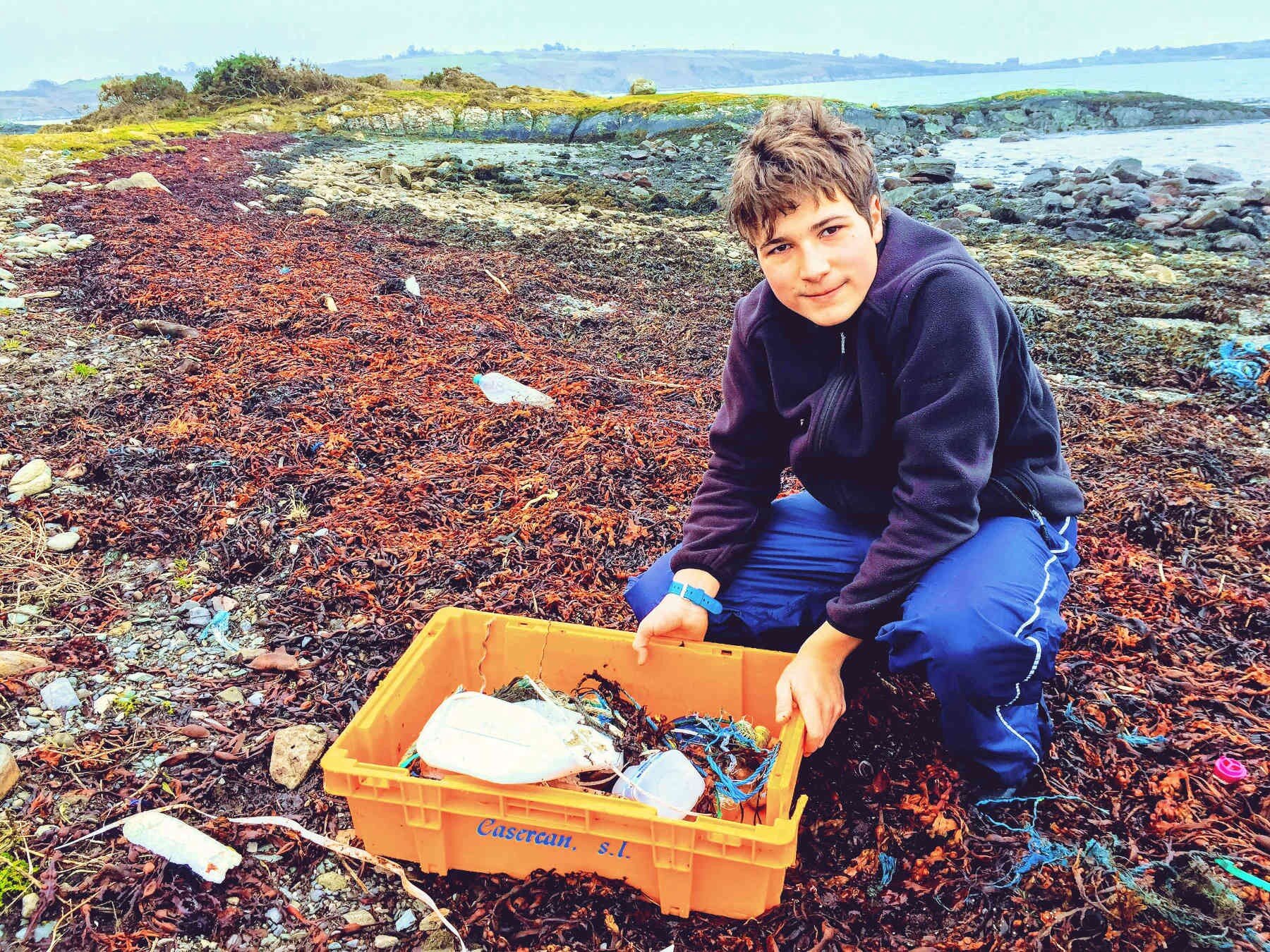
Fionn Ferreira collecting plastic waste

Fionn Ferreira collecting plastic waste

Quality education is the best antidote to poverty, intolerance and oppression. Knowledge is also the key to our future. Here’s the product of good education.

18-year-old Fionn Ferreira, was kayaking one day when he spotted a rock covered in oil from a recent spill. Clinging to the oil was a bunch of tiny pieces of plastic. It got him thinking, in chemistry, like attracts like. Plastic and oil are nonpolar, making them likely to stick together in nature. Because microplastics are so small — some as tiny as grains of sand — scientists have had a hard time figuring out to remove them from the soil and the sea. This Irish teenager has come up with a promising solution for this seemingly impossible task — a magnetic liquid that attracts microplastics to itself. The liquid already exists, developed to keep rocket fuel flowing in zero gravity. Ferreira makes a more environmentally friendly version of the liquid using recycled vegetable oil. The method removed 88% of the microplastics in his test samples.

As we read to the end of the Torah each fall, we are reminded that concern with the future is a central tenet of Jewish values. Torah’s laws and values were not merely given to those assembled at Sinai but to all generations. Moses recounted God’s perpetual intention for Torah saying: “I make this covenant, with its sanctions, not with you alone, but both with those who are standing here with us this day before the LORD our God and with those who are not with us here this day.” (Deut. 29:13 – 14). Even those not yet born are intended beneficiaries of our partnership with God. Upholding the covenant transmits the values that safeguard the future: from God empowering Adam to be caretaker for the planet, to the oft repeated directive to protect widows and orphans, and on to the thematic Deuteronomic urging that we choose life. “Choose life so that your offspring may thrive” (Deuteronomy 30:19).

This belief system is given over as Moses ends his tenure as leader in favor of his younger successor, Joshua, when the Israelites are about to enter their promised land. We learn that even at the most critical moments the future not only belongs to young people but also must be shaped by younger leaders.

Perhaps the keys to a better future are best placed in the hands of those who are most affected. The future should be theirs to design. The young leaders of today are already successful advocates on existential issues for the future.

I am inspired by the young adults from this community who are leading the way on caring for the stranger, helping the disadvantaged, ending corruption. They are Kerry Brodie of Emma’s Torch, Max Levitt of Leveling the Playing Field, and Rabbi Michael Pollack of March on Harrisburg.

Young people are shining the brightest light to illuminate the way forward. Older generations do well to follow their lead and support their causes. Otherwise we have no answer to offer future generations who will ask why we did so little to reverse global warming, enact gun ownership proscriptions, provide universal health care and secure a good education for all children.   

Just as Deuteronomy comes to a close with the poem song, Haazinu, I offer the Debbie Friedman song that linked the goals of young and old alike as a closing prayer:

“And the old shall dream dreams, and the youth shall see visions,
And our hopes shall rise up to the sky.
We must live for today; we must build for tomorrow.
Give us time, give us strength, give us life.”

Rabbi Evan J. Krame


*The phrase “don’t trust anyone over thirty” was coined by Jack Weinberg of California.

We have a certain fascination with large crowds. From attendance at ball games to climate strikers in Foley Square, we often focus on the numbers of people who show up en masse. The larger the crowd, the more excited we may be about participation. I would like to offer a corrective. The critical question is not how many showed up but with whom did you stand and why?

Torah’s parshat Nitzavim begins by describing who has gathered to affirm the covenantal relationship with God as the Israelites are about to enter their promised land.  Who is there? “You stand this day, all of you, before God—your tribal heads, your elders and your officials, all the men of Israel, your children, your wives, even the stranger within your camp, from woodchopper to water drawer.” Deut. 29:9 -10.  Not only those present, but also “those who are standing here with us this day before the LORD our God and with those who are not with us here this day.” Deut. 29:14. Talk about crowd size! This gathering includes all souls that have passed and all lives yet to be born.

God intends for us to gather to confirm the values of this covenantal relationship. We are admonished not to follow one’s own heart. To be concerned with one’s self is blasphemous.  Rather we are commanded to love God, to walk in Godly ways, and to keep God’s rules. And we best honor the covenant when we act in holy community. The “reward” offered is that we may thrive and increase, and be blessed.

As we prepare to gather for Rosh Hashanah and Yom Kippur, many of us will focus on the crowd size.  Perhaps the room will be packed on the first day of Rosh Hashanah and it will be hard to find a chair.  Maybe the crowd size will be down and you will bemoan the loss of membership units. Let’s put that numbers discussion aside.

I suggest new numbers for these High Holidays to focus on the values you affirm by gathering together as a community in prayer.  Count the number of blessings in your life. Calculate the times you failed to act in Godly ways. Tally up the good deeds you did for others. Reckon the times you followed your own heart to the disadvantage of others.

And when we stand together in prayer, as you contemplate self-improvement, devote your intentions so that your teshuva is not only for your own sake but for all those who are not even alive yet that day.  Stand together as a holy community for the purpose of creating a better you and a better world.

Rabbi Evan Krame

Israel has become well known for vineyards — not only the wines but also the vineyards themselves. During a recent trip, I was eager to visit an Israeli winery and vineyard. Our travel companions had the right connection: a retired Jewish musician from Tel Aviv who had bought a vineyard near Bet Shemesh. Nearby was the Valley of Ella, where David slew Goliath. The musician turned vintner offered us a tour, wine tasting and lunch.


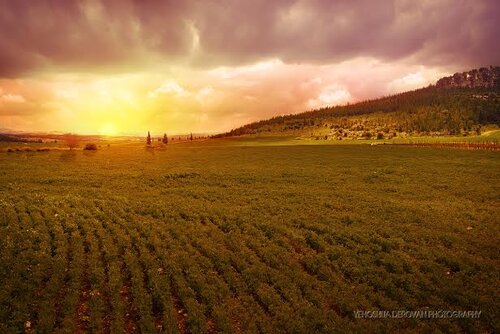
The valley of Ella at sunset

The valley of Ella at sunset

The highway out of Jerusalem leads to a side road, then winding road, then dirt road. The vineyard was in a moshav, an agriculture-based housing development. The vineyard was barely two acres – maybe less. The musician and his wife were the proprietors, vintners, sales staff and farm hands. When harvest time came, their children and grandchildren gathered from across Israel to pick and collect the grapes. A building too small to be a warehouse held a few vats of fermenting grapes and a few barrels of varietal wines.

I wondered aloud if the wines were kosher. No one but the family harvested or produced the wine, so only Jews were involved in the wine making process, as halachah required. The ingredients were organic and pure, which passed the eco-consciousness test. So far, the answer seemed clear enough. 

Then I asked when they starting making the wine. They began, they said, during the first year that the grapes were full enough for the press.

“What did you do with that wine,” I inquired.

“We sold it to friends,” they said, proud of their folksy entrepreneurship.

I thought of the Torah text for this coming week. “Take some of every first fruit of the soil, which you harvest from the land that your God is giving you, put it in a basket and go to the place where your God will choose to establish God’s name” (Deut. 11:2). Torah continues: “You will enjoy, together with the Levite and the stranger in your midst, all the bounty that your God bestowed on you and your household” (Deut. 11:11). 

Why? Torah gives the reason in the verses between these two teachings: because God rescued us from slavery in Egypt.

I believe that our musician’s wine wasn’t kosher because he hadn’t shared it with holy intention. He didn’t share it with community servants or strangers in need.  He seemed not to consider that once we (including he himself) were oppressed and then saved. He seemed to forget that what we have is not ours alone: our history then and our spiritual identity now call us to demonstrate gratitude for our good fortune by sharing our abundance with others before we take any for ourselves.

Kashrut rules can be bewildering. But for all the details, one idea should be far more straightforward: holy eating and drinking flow from means of production that are based in gratitude.

The same principle should apply to our other careers. A “kosher” lawyer should provide free legal services to the disadvantaged and vulnerable. A “kosher” hair stylist should offer free haircuts in homeless shelters. And these gifts of gratitude for our skills and opportunities should come before we ourselves profit by them.

Get out there and give. There is a whole world of “levites” (public servants) and “strangers” (vulnerable people of all kinds). They need you – and you need them. The labors of our hands cannot be “kosher” without giving to them, and without giving to them first.

Rabbi Evan Krame

Anderson Cooper recently interviewed Stephen Colbert for CNN. The two men had a tearful discussion of life’s challenges and the precariousness of human existence. Cooper seemed to still be suffering the loss of his mother and brother. Colbert had his own intensely sad story to tell.

Colbert suffered a great tragedy when his father and two teenage brothers died in a plane crash. In what seemed an odd turn of phrase, Colbert said that “I love the thing that I most wish had not happened.” Colbert understood his loss through the lens of Catholicism. That religion teaches that God would sacrifice his son for the sake of a better world. With that faith, Colbert was able to feel gratitude even after heartbreak.  Colbert developed an appreciation for the person he became because of the suffering he endured. Had he not suffered, he believes that he would not have grown into a compassionate person who empathizes with the suffering of others.

While Colbert’s approach idolizes the tragedy, Judaism teaches us a slightly different lesson. We are taught to learn from tragedy without idealizing the events. Our response to suffering might allow us to soften the heart and ultimately let the experience strengthen our resolve. Perhaps this approach has become part of our DNA, as Jews we have endured personal and communal tragedies enough to teach us how to persist if not thrive beyond life’s messiness. We learned to respond to but not valorize the suffering.

We rely on the biblical teaching, “You shall not oppress a stranger, for you know the feelings of the stranger, having yourselves been slaves in the land of Egypt” (Exodus 23:9). As Rabbi Shira Milgrom wrote: “we remember our suffering—so that we will feel with those who suffer. We remember our suffering—so that we will nurture the courage to speak out against injustice.  We use our experiences to become the agents of change for a better world.”

I agree with Colbert that tragedy, if understood in a spiritual context, can foster gratitude and compel us to be more empathetic. Gratitude for the gift of life and even for the lessons learned serve as a tool for personal growth. Torah, serving as the Jewish spiritual guidebook, teaches us to remember that life is challenging.  However, we don’t idealize the tragedy. Rather we use the experience of tragedy to expand our hearts and dedicate ourselves to the creation of a better world.

Rabbi Evan J. Krame

Let’s start our day with a prayer for Ruth Bader Ginsburg. God who is merciful and powerful, bless and keep Ruth Bader Ginsburg strong and healthy for the sake of our nation. Amen.

Why the urgency for the protection of just one justice out of nine? Many of us are concerned about the partiality of Supreme Court judges recently appointed to serve. One legal principle at issue is stare decisis – upholding earlier decisions; like Roe v. Wade. Another issue is how we interpret the two hundred year old Bill of Rights. Here’s an example; is a political contribution protected speech? These issues challenge our understanding of what it means to uphold the law. Uncertainty undermines our democracy.


ConstitutionQuizFinal-900.jpg

Americans who advocate for civil rights and liberal values, are fearful of a Supreme Court chock full of Trump appointees. For us, Ginsberg stands between the recidivists and an America that devalues individual rights.

Beyond my political yearnings, I expect judges to be arbitrators not arbitrary, to be cold sober and not cold hearted. As a lawyer of 37 years and a participant in judicial processes, I have read far too many subjective rulings and I have seen retributive behavior from judges. In a democratic nation we should not fear that justices of the Supreme Court will be motivated by a political philosophy or personal bias. Accordingly, supporting the integrity of our judiciary requires judges devoted to process and impartiality.

The Jewish tradition directs justice, justice we must pursue. The word “justice” is repeated to remind us that the pursuit of justice by itself is subject to imprecision and bias. Therefore, the judicial system itself must advance justice in all its practices.

Torah sets out a system by which we select judges. “You shall appoint magistrates and officials for your tribes, in all the settlements that the LORD your God is giving you, and they shall govern the people with due justice.” Deut. 16:18. As Moses presents this in a speech to the people, the instruction is directed to the entire people. Collectively, we are to appoint judges. But in the American system, the executive branch appoints federal judges; a branch that is now occupied by a usurper, a solipsistic con man. Given the myriad lifetime appointments the President has made to the judiciary, his venal legacy will last long beyond his term of office.

Perhaps it is time to reconsider how we select Federal Court judges. Torah suggests electing judges as a superior choice. Electing judges might help to keep Judges accountable for their decisions. On the other hand, the corruption in our electoral systems makes it difficult to guarantee that any elected judge is appropriate to the office and answerable for their determinations. So the election on which we must focus is the upcoming Presidential election.

We must work for the election of a President who will make judicial appointments based upon merit and not political proclivities. Let’s remind presidential candidates of the obligation to advance a just justice. The President is representative of all Americans especially when making appointments to Federal Courts.

Until January 2021, God, please take care of RBG!

Rabbi Evan Krame